- hindi news
- Opinion
- N Raghuraman Column: Ancient Knowledge Explained To Kids Via Science
3 hours ago
- copy link
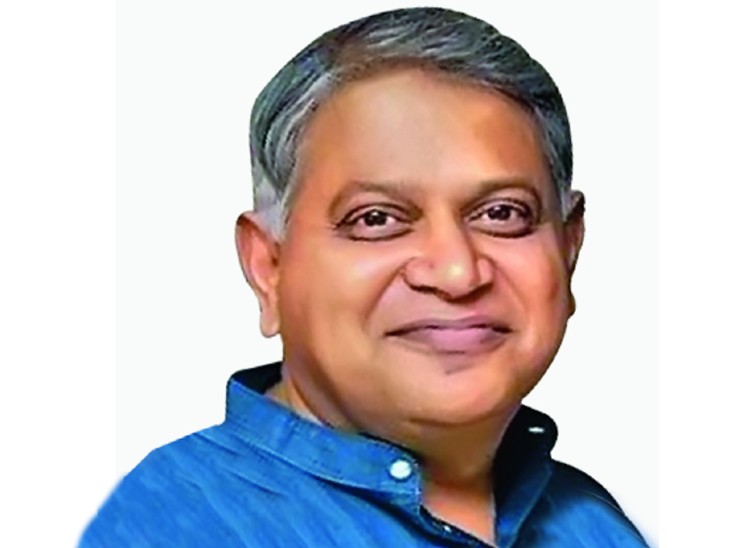
N. Raghuraman, Management Guru
‘How to grow hair fast?’ and ‘Why is my hair falling out?’ These are included in the top ten hair-care related questions searched on Google. Millions of people around the world search using the term ‘hair growth’, even though their queries may vary. During a conversation with Ameev Sharma, Founder and CEO of Kapiva last Tuesday, when I shared this search-related insight with him, he said something that surprised me.
This global need among consumers has made Nutrafol the second largest brand in Unilever’s Wellbeing business, he said. And they are earning full of knowledge of Ayurveda, because the basic ingredient of this product is Shatavari. Our conversation lasted for more than 45 minutes. Finally we came to the conclusion that to increase not only the quality of life but also the bank balance, it is necessary to understand not only Ayurveda but also our ancient knowledge which should be coordinated with modern science.
I was reminded of this conversation this Saturday, when two children from a friend’s family visiting from Australia planned to go out for dinner on Sunday and I requested them not to include me. What I liked about him was that instead of asking why do you keep fast or what is the science behind it, he asked why many generations have been following this tradition for hundreds of years? Many times such a question becomes the beginning of a new scientific discussion.
In support of my beliefs and conduct, I cited the research of Japanese cell-biologist Yoshinori Osumi. He was awarded the Nobel Prize in Physiology or Medicine in the year 2016 for his discovery of the mechanism of autophagy. Autophagy is the process through which cells break down damaged or unnecessary components and recycle them. He did not study Ekadashi for his research nor did he prove that fasting is capable of curing diseases.
However, he brought forward a remarkable fact that when the body faces nutrient deficiency for some time, the cells activate their internal recycling system, which helps in maintaining cellular health. Our ancestors neither had microscopes nor the technology of genetic sequencing. But he had the legacy of centuries of experience and observation.
He observed that eating small amounts of food in moderation improves our health, makes the mind more focused and encourages self-discipline. Many Ayurvedic texts have long recommended ‘Langhan’ – the process of reducing the load on the digestive system – as a way to restore balance in the body.
Modern lifestyle often moves in the opposite direction. We keep on eating something or the other continuously, eat late at night and rarely give the necessary rest to our digestive system. As a result, instead of completing many of its maintenance tasks, the body is constantly busy digesting food.
This is why intermittent fasting has become popular all over the world today. But for millions of Indians, a well-established tradition of periodic fasting on Ekadashi or other prescribed days based on faith has existed for centuries. Whenever researchers present some new benefit of controlled fasting, we are reminded that India’s ancient traditions were often based on close observation of nature and the human body. Long before cellular-recycling was explained in biology textbooks, our ancestors made periodic fasting a part of daily life—not as a medical treatment, but as a wise way of life.
Our ancestors never used words like cellular-recycling, metabolic switching or autophagy. He did not publish research papers. He simply observed nature, seasons, human behavior and health over generations. Their knowledge was developed not from laboratory equipment, but from experience accumulated over centuries. That is why it is not necessary to have a conflicting relationship between tradition and science. Tradition often presents a hypothesis, while science tests it. One preserves experience, the other interprets it.
The bottom line is that Pass on your heritage to the next generation – don’t ask them to blindly believe in it or reject it, but encourage them to explore it with respect and curiosity with the help of science.